More than workers: giving villagers a social life
Right now, our villagers are basically workaholics with zero social life, clocking out only to march straight home like it’s the most exciting part of their day.
So today, we’re changing that by taking a closer look at how villagers spend their free time and how we can make it far more engaging and believable. We are introducing a broader free time system by expanding the range of amenity buildings:
- Tavern
- Theatre
- Church
Additionally, amenity buildings will function more dynamically. They can operate similarly to workplaces, e.g. the tavern consumes beer in its production cycle to create amenity and wealth.
This change adds depth and realism, emphasizing that these buildings rely on active participation from villagers rather than functioning passively.
Free time Decisions
Villagers will no longer automatically return home after work. Instead, they will actively decide how to spend their evening. These decisions are based on personal interests and individual characteristics, e.g. a villager with an interest in music may choose to visit the theatre. This creates more varied, believable, and emergent behavior.
Architectural Changes
As mentioned earlier, we are currently working toward enabling amenity buildings to also function as workplaces, but this is not a finished feature yet. It’s part of a broader architectural shift we’re in the process of implementing.
Previously, our Building architecture relied on a strict inheritance-based approach, where each building had a single, clearly defined role. While this worked for simple cases, it quickly became limiting as soon as we wanted buildings to fulfill multiple purposes. To address this, we are transitioning to a component-based system.
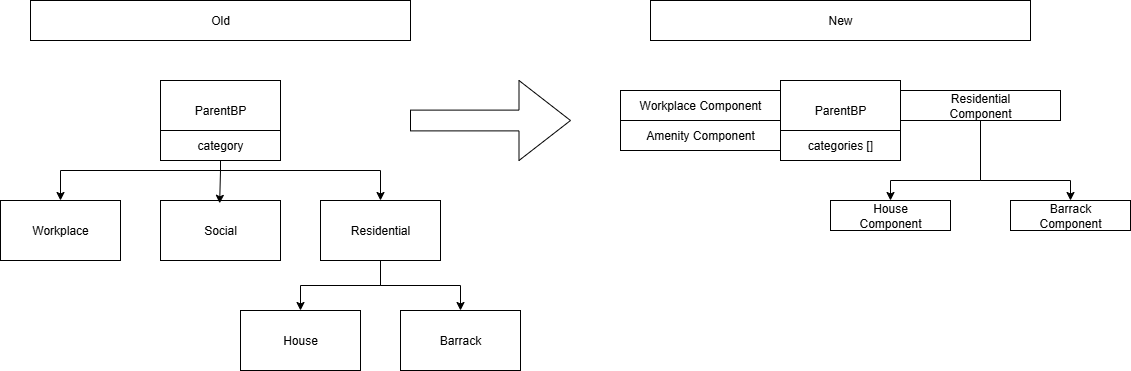
This shift is still in progress, but the goal is to move away from defining what a building is, and instead focus on what a building can do. In this new structure, buildings will be composed of modular components that provide specific functionality. This means a single building can now simultaneously act as:
- Workplace
- Housing
- Amenity
This shift will give us far greater flexibility in design. It allows us to create more complex and believable interactions between systems, reduces rigid dependencies, and makes it significantly easier to extend or iterate on features in the future.
BaseStation System
To support the new free time behaviour, we are generalizing the previous workstation concept into Base Stations.
- Amenity buildings (e.g. taverns) are assigned Guest Stations
- Each visiting villager receives exactly one station (e.g. chair, bench)
- This defines where they stay and interact within the building